
The conversation around gaming hardware often centers on Japanese giants like Sony and Nintendo, or South Korean behemoths like Samsung. But American gaming systems have shaped the industry in ways that echo through every controller press and frame rendered today. From the basement-born Atari 2600 that made home gaming viable to Microsoft’s Xbox empire and the custom PC builders dominating enthusiast circles, the United States has been a relentless force in gaming innovation.
In 2026, the landscape of American gaming hardware is more diverse than ever. Xbox continues its cloud gaming push, NVIDIA’s latest GPUs set performance benchmarks, and a wave of domestic PC builders offer customization that foreign mass-market brands can’t match. Whether you’re spec’ing out a $3,000 rig or deciding between a Steam Deck and Xbox Series X, understanding what “American-made” really means, and where these systems excel, matters more than the marketing suggests.
Key Takeaways
- American gaming systems from companies like Microsoft, NVIDIA, and Valve dominate hardware innovation through GPU advancements, cloud gaming platforms, and open ecosystems that prioritize customization and raw performance.
- From the Atari 2600’s cartridge revolution to the Xbox Series X and RTX 5090, American gaming systems have repeatedly transformed how millions play games, though international competition has intensified since the early 2000s.
- Budget-conscious gamers should choose based on gaming preferences: console players prefer Xbox Series X or S for Game Pass, competitive players demand high-refresh-rate PC setups, and strategy fans require CPU-heavy rigs only available through American custom builders.
- American gaming peripherals like Logitech’s Superlight and mechanical keyboards compete on quality rather than price, while boutique PC builders offer 20-30% premiums over self-builds for professional assembly, testing, and US-based support.
- The future of American gaming systems revolves around AI-driven graphics, cloud-native services that work on any device, and modular hardware—with NVIDIA’s neural rendering and Microsoft’s Game Pass accessibility leading the charge into 2027 and beyond.
What Are American Gaming Systems?
American gaming systems refer to gaming hardware, consoles, PCs, peripherals, and accessories, designed, manufactured, or headquartered by companies based in the United States. The definition isn’t always clean-cut. A console might be designed in Redmond, Washington, but assembled in China or Mexico. A GPU could be engineered in California but fabricated in Taiwan using Dutch lithography machines.
What matters for most gamers isn’t the factory location but the innovation pipeline. American companies drive R&D in GPU architecture, cloud infrastructure, haptic feedback tech, and modular PC design. When we talk about American gaming systems, we’re really talking about the brands and engineering teams pushing the industry forward from US headquarters.
Key categories include:
- Consoles: Xbox Series X
|
S from Microsoft
- Gaming PCs: Custom builders like Origin PC, Maingear, and Falcon Northwest
- Components: NVIDIA GPUs, AMD processors, Corsair memory and cooling
- Peripherals: Logitech mice and keyboards, Razer controllers, Turtle Beach headsets
- Platforms: Steam (Valve), Xbox Cloud Gaming, GeForce NOW
Not every component inside these systems is US-made. Global supply chains mean your American-branded GPU uses memory from South Korea and capacitors from Japan. But the design philosophy, performance targets, and software ecosystems are distinctly American, prioritizing raw power, customization, and open platforms over the more curated experiences from Japanese console makers.
The History of American Gaming Systems
The Atari Era: Pioneering Home Gaming
The story starts in 1972 when Nolan Bushnell and Ted Dabney launched Atari and brought Pong to arcades. But the real earthquake hit in 1977 with the Atari 2600, the first wildly successful home console. Cartridge-based games meant your system could play dozens of titles instead of just built-in Pong clones.
The 2600 sold over 30 million units and established the business model the industry still follows: sell hardware at a loss, profit on software. Atari’s dominance lasted until 1983, when the market collapsed under a flood of shovelware (looking at you, E.T.). That crash nearly killed home gaming in North America and opened the door for Nintendo’s 1985 resurrection.
The Rise and Fall of American Console Dominance
After Atari stumbled, American console efforts fragmented. Companies like Mattel (Intellivision) and Coleco (ColecoVision) had brief moments, but Japanese firms, Nintendo, Sega, then Sony, owned the living room from 1985 to 2001.
Microsoft changed that calculus in 2001 with the original Xbox. Built around a custom Intel Pentium III and NVIDIA GPU, it was essentially a PC in a black box. The gamble paid off: Xbox Live (2002) created the template for online console gaming, and franchises like Halo moved millions of units.
The Xbox 360 (2005) cemented Microsoft as a console heavyweight, outselling the PlayStation 3 in North America for most of that generation. But the Xbox One (2013) stumbled badly with its always-online DRM messaging and weaker GPU compared to PS4. Microsoft’s been clawing back ever since with Game Pass, backwards compatibility, and the 12-teraflop Xbox Series X (2020).
American console dominance never fully returned, but Microsoft’s willingness to burn billions on ecosystem buildout means Xbox remains the only real Western alternative to Sony and Nintendo.
The PC Gaming Revolution
While consoles grabbed headlines, American companies built the PC gaming juggernaut. Id Software launched the FPS genre with Wolfenstein 3D (1992) and Doom (1993). Blizzard Entertainment turned real-time strategy and MMOs into cultural phenomena with StarCraft (1998) and World of Warcraft (2004).
On the hardware side, NVIDIA and AMD (formerly ATI post-2006 acquisition) waged GPU wars that delivered exponential performance gains. The GeForce 256 (1999) introduced hardware transform and lighting. The GTX 1080 (2016) made 4K gaming viable. The RTX 4090 (2022) brought real-time path tracing into reach.
Valve’s Steam platform (2003) became the default PC game storefront, and the Steam Deck (2022) proved American companies could build competitive handheld hardware. PC gaming’s openness, mod support, and performance ceiling remain distinctly American values.
Major American Gaming Hardware Manufacturers
Console Manufacturers
Microsoft is the lone American console maker still standing. The Xbox Series X (November 2020) and Series S offer 12 and 4 teraflops respectively, both running custom AMD Zen 2 CPUs and RDNA 2 GPUs. Game Pass Ultimate bundles cloud gaming, day-one first-party releases, and an EA Play subscription for $16.99/month as of March 2026.
Valve’s Steam Deck (launched February 2022, refreshed with OLED model November 2023) blurs the line between handheld and PC. The current LCD model starts at $399 with 256GB NVMe, while the OLED version ($549) adds a 90Hz HDR screen and better battery life. It runs SteamOS (Arch Linux-based), plays most of your Steam library, and can be docked for 4K output.
PC Gaming Hardware Leaders
NVIDIA commands roughly 88% discrete GPU market share as of Q4 2025. The GeForce RTX 50-series (launched January 2026) brought major DLSS 4.0 improvements and neural rendering tech that many gaming hardware leaks covered months in advance. The flagship RTX 5090 delivers roughly 35% better rasterization than the 4090, with 24GB GDDR7 and a $1,999 MSRP.
AMD (headquartered in Santa Clara, California) fights back with better price-to-performance in the midrange. The Radeon RX 8700 XT ($549, March 2026 launch) trades blows with the RTX 5070 while undercutting it by $50. AMD’s Ryzen 9 9950X3D (16-core, 3D V-Cache) is the gaming CPU king as of early 2026, beating Intel’s Core Ultra 9 285K in frame-time consistency.
Intel is the dark horse. After years of GPU false starts, the Arc B-series (launched Q4 2025) finally delivers competitive ray tracing performance at the $250–$400 price bracket. Arc B750 beats the RTX 5060 in raster at $329, though driver maturity still lags.
Corsair (Fremont, California) dominates enthusiast memory, cooling, and power supplies. Their Dominator Titanium DDR5-6400 kits and iCUE Link ecosystem make cable management almost painless.
Peripheral and Accessory Companies
Logitech (dual HQ in Newark, California and Lausanne, Switzerland) owns the mainstream peripheral market. The G Pro X Superlight 2 remains the esports standard for tac shooters, 58g, 32,000 DPI HERO 2 sensor, 95-hour battery.
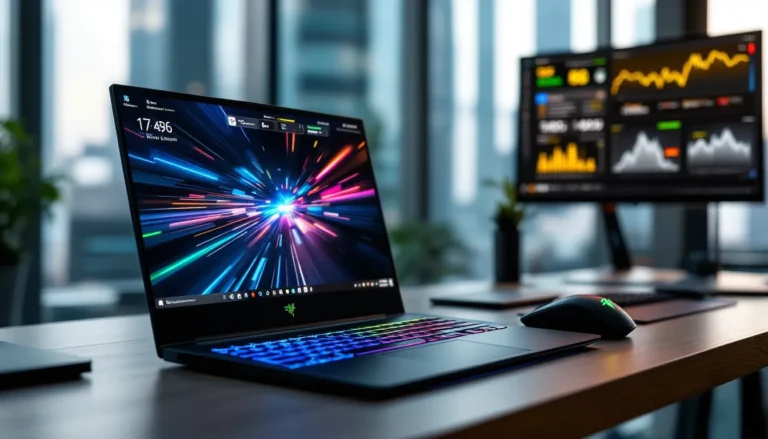
Razer (Irvine, California and Singapore) targets the RGB crowd. The BlackWidow V4 Pro with analog optical switches offers adjustable actuation and per-key lighting, while the Viper V3 Pro competes directly with Logitech’s Superlight.
Turtle Beach (San Diego) and ASTRO Gaming (San Francisco, owned by Logitech since 2017) lead console headset sales. The Stealth Pro ($329) offers active noise cancellation and swappable batteries, rare in gaming headsets.
SCUF Gaming (Marietta, Georgia, owned by Corsair) builds pro-grade controllers with back paddles and adjustable trigger stops. Their Xbox Envision Pro ($279) includes interchangeable thumbstick modules and rumble intensity controls.
American-Made Gaming PCs and Components
Custom PC Builders Based in the USA
Several US-based boutique builders assemble gaming PCs domestically, though “American-made” is a spectrum. These companies design configs, hand-pick components, build and test systems in US facilities, then ship direct.
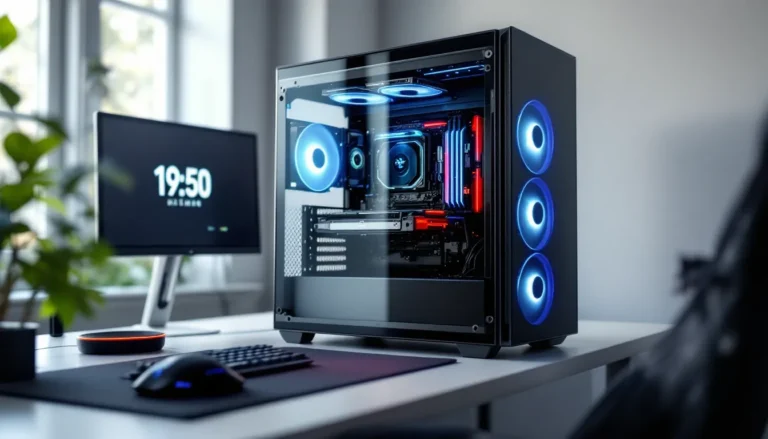
Origin PC (Miami, Florida) offers extreme customization. Their Genesis full-tower supports dual RTX 5090s, custom hard-tubing water loops, and hand-painted chassis. Builds start around $2,000 for entry configs: flagship systems push $8,000+. Assembly happens in their Miami facility with 72-hour burn-in testing.
Maingear (Kenilah, New Jersey) focuses on clean cable management and aesthetic builds. The MG-1 Ultimate ($4,599 base) uses a custom in-house case with tempered glass and integrated RGB. All systems are assembled and tested in New Jersey.
Falcon Northwest (Medford, Oregon) has built boutique PCs since 1992. Their Talon compact gaming rig emphasizes low noise, custom fan curves, sound-dampening materials, and hand-painted artwork on the case. Builds average 10–14 days from order to ship.
Digital Storm (Fremont, California) targets competitive gamers. The Lumos series uses performance-binned CPUs and GPUs (chips tested to guarantee higher-than-spec clocks). Their Velocity Micro liquid cooling keeps thermals in check during long sessions.
These builders cost 15–30% more than equivalent self-built rigs, but you’re paying for warranties, cable management, stress testing, and US-based support.
Graphics Cards and Processing Power
NVIDIA’s RTX 5090 defines the 2026 high-end: 21,760 CUDA cores, 96MB L2 cache, 600W TDP. It hits 120+ fps at 4K ultra in Cyberpunk 2077 with path tracing and DLSS 4 Quality mode. The RTX 5080 (16GB GDDR7, $999) offers 80% of that performance for half the price.
AMD’s RX 8800 XT ($699, expected Q2 2026) aims to challenge the 5080 with better raster but weaker ray tracing. The RX 8700 XT already sits at the performance sweet spot: 1440p ultra in AAA titles, $549 street price.
Intel’s Arc B770 ($399) is the surprise value play. It matches the RTX 5060 Ti in modern DX12 titles, especially at 1440p, and beats it in ray tracing thanks to second-gen Xe-cores. Driver overhead still hurts in DX11 games, though.
On the CPU side, AMD’s Ryzen 9 9950X3D ($649) offers 16 cores, 32 threads, and 128MB of 3D V-Cache. It dominates in CPU-bound scenarios, Cities: Skylines II, Total War, flight sims. Intel’s Core Ultra 9 285K ($589) offers better productivity performance but trails in gaming by 8–12% on average.
Gaming Peripherals: Controllers, Keyboards, and Mice
American peripheral brands cover every input method, from esports mice to couch controllers.
Mice: Logitech’s G Pro X Superlight 2 (58g, $159) and Razer’s Viper V3 Pro (54g, $149) battle for the competitive crown. Both use optical switches (70M+ click lifespan), 8,000Hz polling, and symmetrical shells. For MMO players, Corsair’s Scimitar Elite ($129) packs 12 side buttons and a 26,000 DPI sensor.
Keyboards: Mechanical switches dominate. Corsair’s K70 Max ($219) uses MGX hyperdrive switches, linear with 1mm actuation and 0.4mm travel for ludicrous speed. Razer’s Huntsman V3 Pro ($249) offers analog optical switches for racing games and smooth movement in Valorant. SteelSeries (Chicago-based) counters with the Apex Pro TKL Gen 3 ($199), featuring adjustable actuation (0.2–3.8mm) and OLED screen for Discord notifications.
Controllers: Microsoft’s Xbox Elite Wireless Controller Series 2 Core ($129) strips some accessories to hit a lower price while keeping back paddles, adjustable tension thumbsticks, and trigger locks. The full Series 2 ($179) adds a charging dock and extra components.
SCUF’s Reflex Pro ($259) offers four back paddles, removable faceplates, and instant trigger actuation for COD and Apex. It’s wired-only but latency-obsessed comp players don’t care. Their Envision Pro adds wireless, swappable sticks, and works across Xbox and PC.
Headsets: Turtle Beach’s Stealth Pro ($329) pioneered dual hot-swappable batteries, one charges in the dock while you use the other. Active noise cancellation blocks room noise during streams. ASTRO’s A50 X ($379) is the first headset to switch seamlessly between Xbox, PlayStation, and PC with a single button press, using HDMI passthrough for game audio.
Logitech’s G Pro X 2 Lightspeed ($249) went wireless with 50mm graphene drivers and Blue VO.CE mic filters. It’s the most common headset at LAN events for a reason, comfort during 8-hour sessions and zero interference even in crowded venues.
The Current State of American Gaming Systems in 2026
Cloud Gaming and Streaming Platforms
Microsoft’s Xbox Cloud Gaming (part of Game Pass Ultimate) streams over 400 titles to phones, tablets, and browsers at up to 1080p/60fps. The service added 4K/60fps streaming in December 2025 for select titles (Forza Motorsport, Flight Simulator 2024) on supported devices. Input lag averages 35–50ms on a solid connection, playable for RPGs and strategy games, rough for twitchy shooters.
NVIDIA’s GeForce NOW Ultimate tier ($19.99/month) streams at 4K/120fps with RTX enabled, assuming you own the games on Steam, Epic, or Ubisoft Connect. The service uses NVIDIA’s server farms packed with RTX 50-series hardware, delivering performance no $500 console can match. Recent coverage on Xbox Cloud Gaming expansion showed Microsoft pushing mobile-first strategies as hardware sales plateau.
Valve’s Steam Link app is free and streams from your local PC to phones, tablets, or Steam Deck. Not cloud gaming, but essential for couch play without moving your rig.
VR and AR Gaming Technologies
Meta (Menlo Park, California) dominates VR headset sales. The Quest 3 ($499 for 128GB, launched October 2023) uses pancake lenses for a slimmer profile, mixed-reality passthrough, and a Snapdragon XR2 Gen 2 chip. It runs standalone or connects via Meta Quest Link to a gaming PC for PCVR titles.
Meta’s Quest Pro ($999, launched October 2022) adds eye tracking, face tracking, and higher-res displays. It’s aimed at productivity and social VR but works fine for flight sims and racing games where peripheral vision matters.
Valve’s Index ($999, launched 2019) is aging but still favored for sim racing and Half-Life: Alyx. The Index 2 is rumored for late 2026, possibly with wireless capability and foveated rendering.
Apple’s Vision Pro ($3,499, launched February 2024) offers mixed reality with micro-OLED displays (3,680 x 3,140 per eye) and eye-tracking input. Gaming isn’t the focus, but ports of Resident Evil Village and No Man’s Sky run natively. The price and weight (600g) limit its gaming appeal.
AR gaming on phones remains niche. Niantic’s Pokémon GO still pulls millions of players, but no American company has cracked a mainstream AR headset yet.
American Gaming Systems vs International Competitors
Performance and Innovation Comparison
Consoles: Xbox Series X matches PlayStation 5 in raw specs (both use custom AMD RDNA 2 GPUs), but Sony’s first-party exclusives and DualSense haptics give it the edge for many players. Nintendo Switch (launched 2017, still selling strong in 2026) can’t compete on power but dominates portability and first-party IP.
Microsoft’s innovation focus is software: Game Pass day-one releases, backwards compatibility across four console generations, and FPS Boost patches for older titles. Sony innovates in controller tech and exclusives. Nintendo innovates in gameplay concepts.
PC Hardware: American GPU and CPU makers (NVIDIA, AMD, Intel) face limited competition. South Korea’s Samsung makes GDDR memory but not discrete GPUs. Taiwan’s TSMC fabs the chips, but the architecture comes from California and Texas.
Japanese companies (Sony, Panasonic) exited the PC component market years ago. China’s Loongson and Zhaoxin CPUs can’t match AMD or Intel in gaming. American silicon dominates because the R&D budgets and engineering talent pools are here.
Peripherals: Logitech and Razer compete with European brands (SteelSeries is Danish-owned but US-designed) and Asian budget options. Performance-wise, there’s little difference in sensor tech, most use PixArt sensors regardless of brand. The competition is in build quality, software ecosystems (Logitech G Hub vs Razer Synapse), and warranty support.
Price and Value Proposition
American gaming systems rarely win on price. Xbox Series X ($499) matches PS5 ($499), but both cost more than building an equivalent gaming PC in regions with cheap component access. In the US, a $700 PC build (Ryzen 5 7600, RX 7600, 16GB DDR5) offers similar raster performance but worse optimization and no physical media.
Custom American-built PCs cost 20–30% more than self-built equivalents. You’re paying for labor, testing, and warranties. Origin PC charges $200–$400 assembly fees on top of component costs. International brands like Alienware (Dell-owned, designed in Texas but made overseas) and ASUS ROG offer similar performance for less.
Peripherals show tighter margins. A Logitech G Pro X Superlight 2 ($159) competes with Razer Viper V3 Pro ($149), Finalmouse UltralightX ($189), and budget options like the Glorious Model O 2 ($79). Performance differences shrink as you move down the price ladder, sensors are good enough across the board in 2026.
The value proposition for American gaming systems isn’t price. It’s ecosystem integration (Game Pass, Steam), customization depth (boutique PCs), and cutting-edge tech (NVIDIA’s DLSS, AMD’s 3D V-Cache). If you want the fastest GPU, it’s coming from an American company. If you want the cheapest handheld, it’s probably the Miyoo Mini from China.
How to Choose the Right American Gaming System
Budget Considerations
Set a realistic budget before you spec anything. Gaming systems scale from $300 to $8,000+, and performance doesn’t scale linearly.
Under $500: Xbox Series S ($299) or Steam Deck LCD ($399). The Series S hits 1440p in most titles with dynamic resolution scaling and plays the entire Xbox ecosystem. The Deck gives you PC gaming portability and mod support but weaker performance in demanding AAA titles.
$500–$1,000: Xbox Series X ($499) or a budget self-built PC (Ryzen 5 7600, RX 7600 XT, 16GB DDR5, 1TB NVMe). The Series X offers plug-and-play convenience and Game Pass. The PC gives you Steam sales, free online multiplayer, and upgrade paths.
$1,000–$2,000: Mid-range custom PC from Origin PC or self-built (Ryzen 7 9700X or Core Ultra 7 265K, RTX 5070, 32GB DDR5). Handles 1440p ultra in every current game and 4K medium in most. Add a quality 1440p/165Hz monitor ($300–$500).
$2,000–$4,000: High-end rig (Ryzen 9 9950X3D, RTX 5080 or 5090, 32GB DDR5-6400, 2TB Gen 5 NVMe). This is 4K/120fps territory with ray tracing enabled. Pair with a 4K/144Hz OLED or miniLED display ($800–$1,200).
$4,000+: Boutique builds with custom water cooling, dual GPUs for productivity/streaming, and aesthetic mods. Performance gains over the $2,500 tier are marginal for gaming alone.
Don’t forget peripherals. Budget $300–$600 for a decent mouse ($80–$160), mechanical keyboard ($100–$200), and headset ($100–$250).
Gaming Preferences and Platform Selection
Your game library and play style matter more than specs.
If you play competitive FPS (Valorant, CS2, Apex Legends): Prioritize high refresh rates and low latency. A PC with a mid-range GPU (RTX 5060 Ti or RX 8700 XT), 1080p/360Hz monitor, and low-latency peripherals (Logitech Superlight, 1000Hz polling keyboard) beats a 4K console setup. Many achievement guides and Game Pass updates detail performance modes for console players, but competitive players still lean PC.
If you play story-driven AAA (Cyberpunk, Starfield, Elden Ring): Xbox Series X with Game Pass or a $1,500 PC (RTX 5070, 1440p/144Hz display) handles everything at high settings. Consoles offer HDR and Dolby Atmos out of the box: PCs require more setup.
If you play strategy, simulation, or MMOs (Cities: Skylines II, MSFS 2024, WoW, EVE Online): PC only. These genres need CPU horsepower (Ryzen 9 9950X3D or Core Ultra 9 285K), mouse-and-keyboard precision, and mod support. Xbox supports mouse and keyboard but has limited strategy game libraries.
If you want portability: Steam Deck OLED ($549) is the American option. It runs your Steam library, supports dual-boot Windows, and docks to a TV. ROG Ally and Legion Go (non-US brands) offer better raw performance but worse software integration.
If you’re invested in Xbox exclusives (Halo, Forza, Gears, Flight Simulator): Series X or a Windows PC with Game Pass. All Xbox exclusives launch on PC day-one, so choose based on budget and preference for couch vs desk gaming.
If you create content or stream: Invest in a PC with strong multi-core CPU (Ryzen 9 or Core Ultra 9), 32GB+ RAM, and an NVIDIA GPU for NVENC encoding. The RTX 5070 and up include AV1 encoding, which cuts bitrate requirements by 30% compared to H.264 at the same quality.
The Future of American Gaming Hardware
American gaming companies are betting big on three trends: AI-driven graphics, cloud-native gaming, and modular ecosystems.
NVIDIA’s roadmap through 2027 focuses on neural rendering and AI frame generation. DLSS 4 already generates 7 out of every 8 frames in supported titles, letting an RTX 5070 match native 4K performance of an RTX 4090. The next step is AI-driven asset generation, procedural textures and geometry refined in real-time by on-GPU neural networks. Expect this in the RTX 60-series (rumored late 2027 or early 2028).
AMD’s 3D V-Cache is expanding beyond CPUs. The Radeon RX 9000-series (expected Q1 2027) may include 3D-stacked Infinity Cache to improve ray tracing performance without ballooning power draw. AMD’s betting that efficiency gains matter more than brute-force teraflops as thermal limits tighten.
Microsoft’s hardware future is cloud-first. Xbox consoles will continue, rumors point to a mid-gen Series X refresh with RDNA 4 GPU in late 2026, but the focus is making Game Pass accessible on Samsung TVs, Meta Quest headsets, and Amazon Fire sticks without dedicated hardware. The Xbox app on phones already streams at 4K: expect Microsoft to position Xbox as a service, not a box.
Valve’s next moves likely include the Steam Deck 2 (rumored for 2027 with RDNA 4 or custom Zen 5 APU) and possibly a return to VR with Index 2. Valve’s interest in handheld PC gaming and VR suggests they’ll keep iterating on hardware where they see Sony and Microsoft underserving enthusiasts.
Intel’s Arc roadmap through Battlemage (current) and Celestial (2027) aims to challenge NVIDIA in ray tracing and upscaling. If Intel can deliver an $800 GPU that trades blows with the RTX 6080, they’ll force pricing competition NVIDIA has avoided for years.
Modular PCs and upgradeable handhelds are gaining traction. Framework (San Francisco-based) proved modular laptops can work: gaming handhelds with swappable SSDs, batteries, and even compute modules may follow. Valve already supports SSD upgrades in the Steam Deck: expect future devices to let you swap the entire APU module.
The shift away from silicon node shrinks (5nm to 3nm gains are marginal compared to 28nm to 14nm jumps) means future performance comes from architecture, AI, and better thermals. American companies have the software expertise to leverage AI acceleration: whether they can maintain manufacturing partnerships as geopolitical tensions rise is the bigger question.
Conclusion
American gaming systems have never been just about raw specs or patriotic branding. They’ve defined how we play, through Xbox Live’s unified online infrastructure, Steam’s open PC ecosystem, NVIDIA’s relentless GPU advancements, and boutique builders who treat cable management like an art form. In 2026, the landscape is more diverse than the Atari and early Xbox eras, but the through-line remains: innovation at the high end, ecosystem integration, and a bet that gamers will pay for performance and customization.
Whether you’re chasing 4K/120fps with an RTX 5090, grinding ranked on a Logitech Superlight, or streaming Starfield on your phone via Game Pass, American hardware and platforms shape the experience. The competition from Japan, South Korea, and Taiwan is fierce, but when it comes to pushing the performance envelope and building open platforms, US companies still set the pace. The question isn’t whether American gaming systems matter, it’s which one fits your budget, library, and tolerance for RGB.